Tuesday, November 25, 2008

Weather in Durham


A mix of rain and high winds led to dangerous conditions in parts of Maine and New Hampshire this morning, making it difficult for students commuting to campus and travelers heading home early for the holiday.

Power outages spread across New Hampshire in Bethlehem, Durham, Conway, Eaton, Madison, New London, and Tamworth, according to the National Weather Service’s update at 8:25 am. The next update will be available at 10:25 am. All UNH residence halls retained power, despite a few flickerings earlier this morning caused by the wind.

The National Weather Service announced a flood watch at 4:06 this morning for southern Maine and New Hampshire. One to three inches of rain are expected to accumulate throughout the night.

University officials decided against curtailing operations, instead continuing the school day as usual.

If these conditions continue through the night and into tomorrow, holiday travelers can expect delays and lots of traffic. Wednesday, the day before Thanksgiving, is traditionally one of the busiest travel days of the year.

Today’s winds are expected to reach 38 mph, but the Old Farmer’s Almanac predicts that they could occasionally get as high as 50 mph. The rain is expected to taper off as the evening progresses, according to WMUR.

This November has been a little rainier than most in New Hampshire. The Farmer’s Almanac predicts an average of 5.5” of precipitation for November, two inches above average.

Wednesday, November 19, 2008

Technology as a Witness


In today's New York Times, the front page article "Murder Suspect Has Witness That Doesn't Lie: Subway Fare Card" caught my eye immediately. I was interested to find out what exactly that meant. Did his subway card prove he did murder someone, or that he was innocent? I was also curious to find out how exactly his subway card was a witness.

The article starts off with a blind lead, describing some background information on the case before revealing that the suspect's MetroCard has become a key witness. The rest of the article is organized around several main points:
  • The details of the fatal shooting that happened in May
  • The suspect (Jason Jones)'s alibi
  • Why Jones and his brother Corey were arrested
  • How Jones' lawyer got his MetroCard records, which support his alibi
  • Other electronics that confirm Jones' alibi (the punch-clock at his work and a check-cashing outlet)
  • What's happening with the case now
I think this article is really interesting. This man has been in jail since May, but he was finally released on bail thanks to the records from his MetroCard that show that his alibi is true. With all of the technology nowadays, it is sometimes a little scary to think that our every moves can be traced. (The article even mentioned the fear of a "Big Brother"-like society.) But then when something like this happens, it shows that the advancements in technology can be a good thing too, and help justice be served.

From this article, I learned a lot more about the tracking that exists in a lot of newer technology. I was aware of this, to an extent, but I didn't realize that it could be accessed by policemen or other professionals to use as a witness in a murder case. The article said that, if convicted, Jones and his brother could potentially face the death penalty. I think the fact that the records from Jones' MetroCard match up with his alibi and seem to prove that he's innocent is great. I hope that Jones, if he really is innocent, can go free and that the police can focus on finding the true murderer.

Tuesday, November 18, 2008

The French Connection

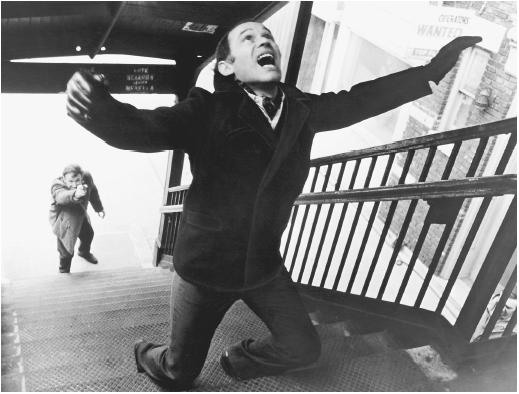
Police Chase and Kill Suspected Assassin

New York City – A suspected assassin was shot and killed Sunday afternoon on the steps of the platform to the 15th St. railway station after a long chase with a New York City police detective.

According to the police report, it took Detective Jimmy “Popeye” Doyle only one shot from his .38 caliber service revolver to kill Pierre Jeantot, 36. Police suspect Jeantot, of Nice, France, had been hired to assassinate Doyle.

“We commend Detective Doyle for his bravery and quick thinking under very trying circumstances,” said Ruth L. Ess, the New York City Police commissioner.

Though details of the case are still being uncovered, police also suspect that Jeantot had been working on behalf of a French drug kingpin that Doyle and his partner, Buddy “Cloudy” Russo, had been investigating.

After shooting at Doyle from the rooftop of an apartment building at 1767 W. 57th Ave., Jeantot hijacked a train at 35th St. Station, according to the police report. Doyle followed the train in a commandeered car until the train stopped at 15th St. Station.

Jeantot left several victims in his wake. Bronx resident Betty B. Badluck, 63, was shot and killed while walking her granddaughter near Doyle’s apartment building this morning. Roland Evans, 34, a 15-year veteran of the New York City Police Department, and Horatio C. Hornblower, 30, the conductor of the train, were both shot by Jeantot on the hijacked train. Trainman Peter Howe, 27, died of a heart attack at the controls of the train.

“It is always unfortunate when these incidents end in a loss of life,” Commissioner Ess said.

According to the police report, Homeland Security records show that Jeantot entered the United States on Nov. 4 from Paris, France. “We suspect he was associated with a crime syndicate that had been laying the groundwork for a major heroin shipment from France to New York City,” Ess said.

Ess said two other men are currently being sought in connection with the drug crime. “We will continue a vigorous and thorough investigation into what appears to be a major smuggling operation.”
*class assignment*

Monday, November 17, 2008

The Adventures of a 12-Year-Old Food Critic


The article that caught my eye in today's New York Times is "12-Year-Old's a Food Critic, And the Chef Loves It" on page A23. The combination of the headline and this picture of a young boy alone at a restaurant really peaked my interest.

This article is a feature article, part of Susan Dominus' "Big City" column, and it used an anecdotal/narrative lead. I really like the conversational tone used to tell the story. It kept it light and fast-paced, which made it a cute and enjoyable piece about a 12-year-old boy with a love for food.

The story was organized as a narrative, and it highlighted several main points. First, Dominus set the scene and explained why this little boy, David Fishman, was eating by himself at a restaurant (his parents were running late and suggested he get some takeout - he asked if it would be okay to go to Salumeria Rosi, a new restaurant he'd been eyeing). Then, she talked about the boy's personal interests in cooking, his experiences at the restaurant, and how he was treated there.

I really loved the cute little touches in this article. The author mentioned the boy's budget ($25), and even some of the notes he made in his little food critic journal ("Good variety" and "Softish jazz music. Seem to enjoy kids but not overly"). I think his notes in his journal are adorable. I'm impressed that this boy is comfortable enough with himself at 12-years-old to eat in a restaurant by himself. I don't think I would want to eat in a restaurant by myself now, and I'm 20!

The fact that the chef of the restaurant took the time to talk with this little boy is really cool, too. It was nice that the chef treated him almost as an equal, and not as a little child who can't handle himself. Clearly David Fishman is much more mature than the average 12-year-old boy.

I'm not sure that I necessarily learned anything from reading this article, but I really enjoyed reading about this little boy's experiences. It did make me wonder, though, about the age minimum for people to eat alone in a restaurant. I'm sure that it depends on the restaurant, but it was a little bit surprising to me that they let a 12-year-old in by himself. I wonder if they would have turned him away had he been 11, like another restaurant did when David tried to dine alone last year.

Friday, November 14, 2008

Catholic Church Stands Firm, No Women Priests


There were a lot of articles that caught my eye in today's New York Times. I perused stories about space plumbers, the skeletons of three siblings found in their sister's home, "Tuba Man," and an earthquake drill in California - all were extremely interesting, but there was one other article that stood out most to me. "Catholic Priest Faces Excommunication" immediately drew me in. I'm a Catholic, and my uncle is a priest, so I wanted to hear more. Excommunication is fairly rare and very serious, so I wondered what this priest had done to face such a severe punishment.

The article began with a basic news summary lead. It then addressed several main points:
  • what the priest, Rev. Roy Bourgeois, did to merit excommunication (he participated in the ordination of a woman as priest, a practice illegal in the church)
  • how he feels about this (he is very upset, but said he "could not disavow his actions")
  • the background of the priest (he has been a member of the Maryknoll religious order for 36 years and has also served as a missionary in Bolivia and El Salvador)
  • other women have claimed ordination in the past (this woman was the 35th American woman to claim ordination; she's a part of a group called the Roman Catholic Womenpriests)
  • what excommunication means (it is "the most severe ecclesiastical penalty," and the person is forbidden to receive or administer sacraments)
  • what will happen now (the priest said he will try to appeal the Vatican's decision)
The story tied these points together in a linear way, so that it began at point A and ended at point F, in this case. Their order was very logical and made it easy for the reader to follow and understand the gravity of the situation.

I had no idea that any women were claiming to be ordained as Catholic priests before I read this article. I think this is incredibly interesting. The fact that there is even an organization for these women kind of astounds me. Personally, I agree with the priest in this story that women should have the right to be a priest if they want to. I think the fact that he stood up for his beliefs, even though it will likely cost him his priesthood, is noble. The Vatican gave him the option of formally recanting what he did, but he decided to stick with what he thinks is right.

I wonder what Rev. Bourgeois will do in the future, after he is excommunicated (if his appeal does not work). He has spent over half of his life in the church, and it will be a huge change to leave it. This article definitely lived up to my expectations, and after reading it I feel like I have actually learned a lot about my religion.

Thursday, November 13, 2008

Ugly Fruits and Vegetables Get Their Day


Upon looking through the New York Times today, one article definitely stood out to me. Located on page A6, "Europe Relaxes Rules on Sale Of Ugly Fruits and Vegetables" made me do a double take. Along with the picture, the headline seemed a little strange and ridiculous, so I wanted to find out more.

The story was brief, but very amusing. The main point was that European Union authorities have gotten rid of rules that ban oddly shaped produce from being sold in supermarkets. Starting in July, the standards for 26 different products (from peas to plums and lots more in between) will end. As one woman put it, "This marks a new dawn for the curvy cucumber and the knobbly carrot." (I really loved that quote.)

The article began with a basic news lead, summarizing the main point of the article, and it continued in a linear manner. It explained to readers that this decision was made partly because of the rising cost of commodities, so the officials figured "there was no point in throwing away food just because it looked strange." Although 16 of the 27 nations in the European Union tried to block the changes, they still passed.

The article also mentioned that 10 other types of fruits and vegetables will still be held to shape standards. Among these are apples, tomatoes, and strawberries.

Prior to reading this article, I had no idea that Europe had any rules for selling weird looking fruit or produce to the public. Thinking about it now, I suppose it makes sense since you don't usually see ugly fruits and vegetables in supermarkets, but it still seems a little strange to me. It made me wonder if the United States has rules like these - I suspect they probably do - and, if they do, if the U.S. will start adjusting their rules as well.

Wednesday, November 12, 2008

Nebraska dips a toe in the Democratic pool


Several articles caught my eye when I was looking through the New York Times today. The one that interested me the most, however, was "Glory for Democrats, Riding on a Single Vote." The headline pulled me in because I was a little confused. Isn't the election already over?

I liked that the article answered my question immediately in the lead. "Yes, county election officials here are certainly aware that the presidential race is considered over and done." This lead seems like a cross between the anecdotal/narrative lead and the direct address lead (although it doesn't use the second person, it does seem to speak to the reader).

The article definitely lived up to my expectations. It talked about how people in Omaha, Nebraska are still counting ballots from last week's election. Though the state as a whole has already been called for Sen. John McCain, Nebraska is one of only two states in the country that splits its electoral votes (Maine being the other), and its final electoral vote is still up in the air.

Apparently, it looks like this final electoral vote will go to Sen. (and now President-Elect) Barack Obama, which is a big deal because Nebraska hasn't given any electoral votes to a Democrat since Lyndon B. Johnson in 1964. I didn't realize that there were any counties in America still counting their ballots, so this article was a bit of an eye-opener.

The story was organized somewhat narratively. The author used qutoes from various people in Nebraska to support the main point that this area of the country is still counting their votes and that it looks like one of Nebraska's electoral votes will go to Obama. She also spent time explaining why Nebraska's taking their time counting their votes. As one man put it in the article, "You can either get instant results or quality results."

I learned that the fact that Obama is likely to receive Nebraska's final electoral vote is very momentous. Like much of the country, Nebraska is slowly becoming moer democratic. As one Democrat said in the article, this electoral vote "puts us Democrats on the map in a place where we've never really been on the map."

The only question I had left after reading the article was about what the final tally of votes is, but the article said that information won't be final until tomorrow.

Tuesday, November 4, 2008

Durham Votes


Durham, N.H. – Hundreds of Durham residents made their way to Oyster River High School bright and early this morning to cast their votes in the historic 2008 campaign.

“The turnout’s been great,” said Larry Brickner-Wood, the Chaplain for the University of New Hampshire and a volunteer at the polls. “I think it might be the best we’ve ever had.”

Oyster River opened their doors at 7 a.m. and the voters have been strolling in ever since. It was the first time working the polls for Tom Poirier, the Deputy Town Clerk, but he was impressed with the voter turnout.

“It’s been slammed since it opened this morning,” Poirier said. “Extremely busy.”

First-time voter Yesenia M. Morris, 18, came early in attempt to avoid long lines. “There was some confusion at first, but they cleared it up,” Morris said. “It took 20 minutes – a half hour at the most.”

Morris, a UNH student, is from Gansevoort, NY, but registered at one of UNH’s Voter Drives so she could vote on Election Day in Durham. Morris said she was “very excited” about being able to vote, but admitted she was a little anxious.

“I was really nervous I’d mess the ballot up,” she said. “It’s kind of intimidating.” Morris’ fears were short lived, however, and her ballot was cast without problems. She voted for Sen. John McCain, who she felt is the “significantly better candidate.”

After the initial confusion and the long lines of people eager to cast their votes, the process was well organized. Most voters said they moved through the line in as little as 10 to 15 minutes.

“My line was short – I was in and out in like 10 minutes,” said Daniel P. Bishop, 18, of Pelham, NH. Bishop, another UNH student who registered to vote at one of the voter drives, said he wasn’t nervous about voting because he’d been to the polls with his parents before.

“I’m glad I got out and voted,” Bishop said. He voted for McCain as well, but feared that it wouldn’t help much in the overall election.

The voting process was a fairly simple one, Deputy Town Clerk Poirier explained. When voters enter the Oyster River gymnasium, they are directed to one of five tables, according to their last name. There, they submit their name and receive a ballot. After filling out their ballot in a private booth, voters then enter a new line, where they hand in their ballots.

“This morning, the ‘M’ [table] line’s been the longest,” Poirier said. “But the lines shift as the day goes on.”

Poirier worked at one of the voting tables early in the morning, where he noticed more of a Democratic presence among voters. Among the voters who registered today, Poirier said there was a pretty even split between Democrats and Independents. “We haven’t seen too many Republicans.”

UNH student Eliza S. Friedman, 21, is from Glastonbury, CT, and voted for Sen. Barack Obama. Friedman registered at one of the voting drives, and came early to the polls to get her vote in before her classes. Despite being nervous about long lines, she found the process fairly easy.

“I think it’s awesome being in a college town,” Friedman said, “and seeing how excited young people get about [the election].”

Brickner-Wood, the UNH Chaplain, agreed. “People are pretty hopeful,” he said, noting that the exuberance of the young people of Durham is great to see. “I’ve heard very few people say they’re not going to vote this year. People feel pretty excited.”

Julie T. Muldoon, 21, is a UNH student from Scarsdale, NY. Muldoon voted for McCain, but said remained undecided until the last minute. “I had no idea who I was voting for until I got in the booth,” she said. She ultimately decided on McCain because she didn’t believe Obama’s plan for change was “big enough.”

Muldoon registered at the polls, and though she was nervous it wouldn’t work, she described the process as being really easy. “I definitely wanted to vote,” she said. “I feel like it’s just lazy not to.”

Some students came because they felt an obligation to participate in such an important election. “I felt like I had to vote,” admitted Taylor R. Hodges, an 18-year-old UNH student from Nashua, NH. “I’m glad I got out here.” Hodges voted for Obama.

Poirier, the Deputy Town Clerk, had yet to cast his own vote, but said he was voting for Obama. Poirier considered himself a staunch Republican until 2004, but the events of the past four years have inspired him to reconsider his views.

“Not only am I voting for Obama, but I’ve been campaigning for him,” Poirier said. “It’s time for a change.”

UNH Chaplain Brickner-Wood is also an Obama supporter. “I think he’s a real leader,” Brickner-Wood said. “[I think he can] bring us together. He’s a good, decent human being.”

Brickner-Wood said that so far it appears that Durham is “an Obama town.”

Today is Brickner-Wood’s 54th birthday, and he hopes it will turn out well. “I’ve had a lot of bad birthdays,” he said, “but I think today could be a good one.”

It won’t be long until Brickner-Wood – and the rest of the country – finds out.